Welcome to Weidong Machines
Tub Grinder Capacity Planning for Orchard Prunings: What Buyers Should Measure
Tub grinder capacity for orchard prunings should be specified through a measurable buying requirement. A request for “high capacity” gives suppliers little information about the material, working window or output the buyer must deliver. A useful specification states the quantity, its measurement basis, the available time and the evidence required for acceptance. This guide helps buyers write that requirement and compare capacity proposals without relying on a headline number.
Choose the quantity that the purchase must deliver
Define whether the target concerns incoming branches processed, accepted output produced, or material removed from the site. Keep these quantities separate. An input target can be met while some output still needs another pass or a disposal decision. Likewise, output production does not prove that collection vehicles can remove it within the customer's deadline. Match the purchase requirement to the actual contractual task.
State the unit and its measurement method. Net mass, loose branch volume and finished-material volume are not interchangeable. Where moisture is measured, identify its reporting basis and sampling method. Do not convert a pile estimate to tonnes with a generic density taken from unrelated chips. If quantity remains uncertain, state a range and explain how it will be measured before acceptance testing.
Describe the feed envelope beside the target
Attach representative orchard sources, pruning types, branch shapes, collection methods and storage histories. Separate routine pruning from occasional heavy limbs. Record leaves and visible contaminants, with the inspection and preparation steps required before release. The supplier should know which material conditions the capacity requirement includes and which are excluded under the machine's permitted-feed limits.
Use the orchard feed-characteristics worksheet to build this evidence. A rate demonstrated on a convenient clean sample should not automatically become the commitment for a broader and more difficult feed envelope. If the representative material changes after ordering, review the test basis rather than assuming the original number still applies unchanged.
Separate the work window from active processing
Record permitted site hours and the tasks that occupy them: setup, inspection, preparation, loading, discharge handling, authorized service and cleanup. Identify which tasks overlap and which stop processing. Do not count the loader as simultaneously feeding the grinder and moving output unless the actual arrangement supports that assumption. Keep relocation and transport visible where the machine serves several orchard sites.
Specify whether the requested hourly rate refers to active processing or the complete elapsed trial. A short active rate can support a machine discussion, while the elapsed rate is needed for scheduling a complete lot. The processing workflow planning framework helps locate shared-resource delays before they become a disputed capacity issue.
Request a capacity statement with conditions
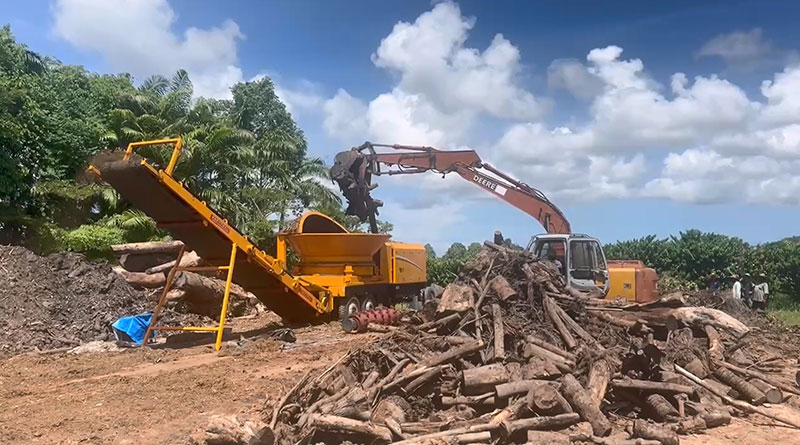
Ask the bidder to attach the proposed machine configuration, supporting loader, discharge arrangement, feed preparation and output requirements to any estimated rate. Ask whether the figure is a measured result, a calculation or an indicative estimate. A useful proposal identifies the evidence behind it and the conditions still needing a trial. It does not conceal uncertainty by presenting extra decimal places.
| Requirement field | Buyer entry | Supplier response needed |
|---|---|---|
| Material boundary | Identified orchard lots and preparation | Permitted feed, exclusions and proposed configuration |
| Quantity boundary | Input or accepted output, unit and method | Comparable rate with the same basis |
| Time boundary | Available window and included tasks | Trial clock and support assumptions |
| Quality boundary | Destination acceptance procedure | Sample method and handling of off-specification material |
| Evidence boundary | Required demonstration record | Measured data, estimates and unresolved limitations |
Write the demonstration procedure before delivery
Agree on representative permitted trial lots, the weighing or volume method, start and finish events, and the person responsible for recording interruptions. Specify how output samples are identified and who determines acceptance. Record the actual machine configuration and any authorized changes. Follow the equipment instructions and site's safety procedures throughout; the purchase specification must not encourage unsafe operating adjustments to chase a target.
Retain rejected material, oversize and repeat passes in the record. If the same material passes through the grinder twice, it is not two separate quantities of fresh production. Include the associated extra time and count accepted material once. Preserve the complete trial record even when a stable segment performs better than the complete lot. That difference may identify a support constraint the buyer needs to resolve.
Compare offers through the same acceptance sheet
Enter each proposal into the same sheet and flag incompatible assumptions. One bidder may include preparation and elapsed delays while another quotes only a brief active-processing observation. Those figures should not be ranked directly. Request clarification before deciding that one machine is more productive. When the configurations differ, also identify any changes in support equipment, transport or output handling.
Use the budget and ROI guide to keep these supporting costs visible. A lower purchase price or higher estimated hourly rate does not by itself establish lower cost for completing the orchard job. Keep local quotations and measured trial evidence separate from assumptions about future operating conditions.
Resolve a missed target with evidence
If a trial misses the agreed requirement, compare the actual feed, configuration, support and time boundaries with the signed procedure. Separate an output-quality issue from insufficient feed availability or blocked discharge. Record corrective actions and the conditions for a repeat test rather than immediately attributing every shortfall to the machine. Do not rewrite the acceptance boundary after the result merely to make the test appear successful.
Send the capacity brief through the project enquiry page with the relevant tub grinder requirements. For a different layout comparison, review the horizontal wood grinder overview using the same measurement boundaries. A clear requirement makes supplier proposals comparable and gives both parties a practical basis for commissioning.