Welcome to Weidong Machines
Land-Clearing Roots Processing Workflow for a Tub Grinder Project
Land-clearing roots tub grinder processing workflow: A land-clearing roots tub grinder processing workflow should be designed from receiving to accepted output before equipment is ordered. Root processing is a coordinated system of survey, segregation, preparation, loading, grinding, discharge, sampling, service, and dispatch. A machine placed in the middle of an undefined pile creates unpredictable feeding, contamination, traffic, and product quality. This project workflow gives owners and contractors stage gates without inventing universal capacity figures.
Survey the material stream
Identify clearing phases, estimated quantity, root-ball dimensions, attached wood, moisture method, visible soil, stones, metal risk, storage surface, and mixture with brush or logs. Create photographs and representative lot IDs. The root selection guide explains the feed-envelope questions.
Separate prohibited or unknown material from difficult but permitted roots. Define the preparation outcome rather than assuming every root ball is ready to grind.
Write the output rule
State the intended use, target size method, oversize and fines limits, visible contamination or ash requirement, moisture basis, sample method, and whether a second pass is allowed. Accepted output, not conveyor discharge, drives capacity and cost.
Use the site's throughput test to distinguish productive grinding rate from gross elapsed project rate. Both should use the same accepted-output definition.
Lay out dirty and clean zones
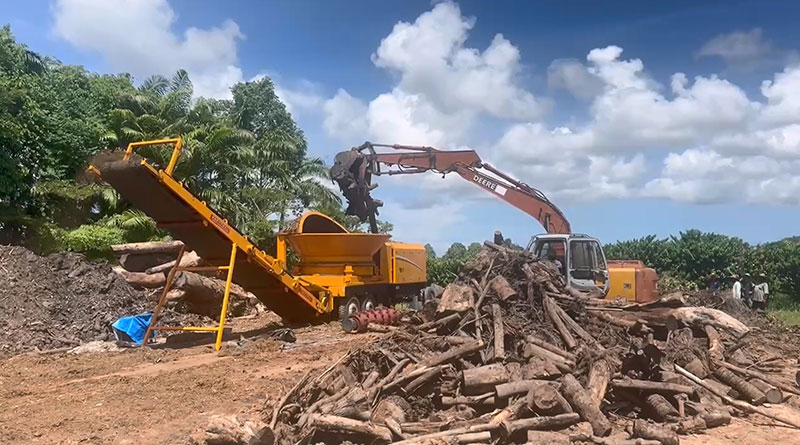
Arrange receiving, inspection, quarantine, preparation, approved feed queue, grinder, discharge, sample point, clean stockpile, trucks, service access, and emergency access. Keep loader travel and pedestrians separated according to the site plan. Drainage should prevent dirty runoff from crossing the clean output route.
Check ground bearing, slope, overhead restrictions, turning space, wind, neighbouring receptors, utilities, lighting, and fire-water access. The layout must match the exact machine, loader, and discharge arrangement.
Design preprocessing
Set rules for shaking, spreading, cutting, sorting, metal checks, and rejecting stones or wire. Measure preparation minutes and reject quantity. U.S. Forest Service research on biomass harvesting operations supports treating soil contact and ash as process variables.
Build a stable approved feed queue without creating an unstable pile or blocking emergency routes. Do not use the loader to force material beyond the approved feed envelope.
Run a controlled configuration trial
Test prepared, normal, and difficult root lots. Record machine, screen, wear condition, loader, operator, input, accepted output, productive time, elapsed time, delay codes, samples, energy or fuel, and abnormal events. Change one major variable at a time.
Review the tub grinder product range only after the trial inputs are documented. Supplier capacity statements should name the tested root condition and output requirement.
Create operating and stop rules
Define communication between loader and grinder operator, start checks, feed presentation, discharge monitoring, contamination response, sample timing, housekeeping, weather holds, and shift handover. Keep people outside machine and loader danger zones.
Jam clearing, internal inspection, screen work, and maintenance require the machine-specific shutdown and hazardous-energy procedure. OSHA's energy-control standard explains the general servicing requirements.
Commission against the project record
Verify installation, guarding, controls, manuals, training, initial spares, service contacts, and the approved work cell. Run identified acceptance lots and compare gross and net accepted output, samples, rejects, delays, and wear observations with the procurement assumptions.
Send the survey, layout, root files, outlet rule, and trial record through the project inquiry page. The matrix engineering tub grinder section provides additional configuration context.
Run a pre-start walkthrough and baseline cycle
Before releasing the workflow for land-clearing roots tub grinder processing workflow, bring the site supervisor, grinder operator, loader operator, preparation crew, maintenance representative, and traffic or safety lead to the marked work cell. Walk the normal material route, quarantine response, hold signal, emergency stop communication, maintenance access, sample collection, output removal, and shift handover. Confirm that signs and physical markings are visible from the operating positions. Record unresolved conflicts and keep production on hold until the responsible person accepts the corrective action under the site procedure.
Then run a controlled baseline with an identified root lot and the approved configuration. Record charge sequence, loader-cycle components, productive and elapsed time, queue stability, preparation, contamination findings, rejects, discharge handling, accepted output, samples, stops, and unusual observations. The baseline is not a capacity promise. It is a reference for detecting when weather, root geometry, soil, loader travel, wear, or downstream congestion changes the system. Repeat it after relocation or a major workflow change.
Manage changes and shift handover
Give the layout and work instruction a revision number. Only an authorized role should change pile locations, routes, exclusion zones, communication signals, preparation rules, screen or operating configuration, or the definition of accepted output. Brief affected personnel before the change becomes active. Keep the old record so incident reviews and production comparisons can identify which method was in force. Temporary workarounds need the same review; repeated informal exceptions are evidence that the workflow or equipment boundary needs redesign.
At handover, state the active root lots, quarantined material, machine and loader condition, ground and weather changes, available discharge space, open holds, maintenance status, samples awaiting results, and corrective actions. The incoming team should confirm the work cell and signals rather than relying only on a written note. Review daily records for recurring contamination, preparation delays, route conflicts, abnormal machine response, or output rejection, and change the process before those signals become routine.
Operate, review, improve
Close every shift with lot IDs, accepted output, rejects, productive and elapsed time, delays, samples, weather, wear observations, and safety events. Review the record when the root source, preparation, screen, outlet, layout, loader, or operator method changes. A stable workflow is a controlled operating window, not a one-time setup photograph.